
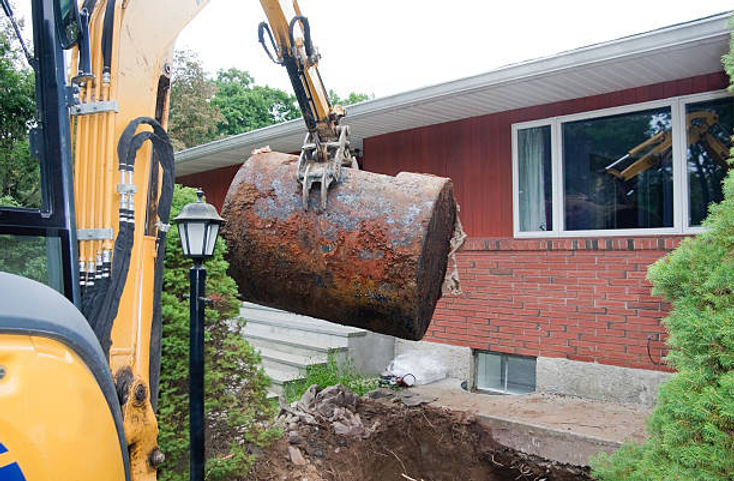
OIL TANK SWEEPS IN NEW JERSEY & NEW YORK
STANDALONE
OIL TANK SWEEP
$275
ADD TO A HOME INSPECTION
$200
SCHEDULE AN OIL TANK SWEEP
What Is an Oil Tank Sweep?
An oil tank sweep is a non-invasive inspection intended to identify evidence of a potential underground heating-oil storage tank.
The process typically includes scanning accessible portions of the property with specialized metal-detection equipment and looking for physical evidence associated with a former oil-heating system.
The purpose is not to excavate the property or determine whether a suspected tank has leaked. Instead, the sweep helps determine whether conditions are present that warrant further investigation before you purchase the home.
If a suspected underground tank or significant anomaly is identified, additional evaluation by a qualified underground storage tank or environmental professional may be recommended.
Why New Jersey Homes May Have Abandoned Underground Oil Tanks?
Many older New Jersey homes were originally heated with fuel oil. As natural gas and other heating systems became more common, homeowners frequently converted their heating equipment and discontinued use of their oil tanks.
Some underground tanks were professionally removed. Others were legally abandoned in place, while the history of still others may simply have been lost through decades of property transfers, renovations and changes in ownership.
A home that currently has natural-gas heat can therefore still have evidence of a former oil-heating system — and potentially an underground tank.
This is particularly important during a real-estate transaction because the NJDEP oversees remediation when a discharge from an unregulated heating-oil tank is discovered. A tank that was previously abandoned in place also does not, by itself, establish that the tank never leaked.
For a buyer, discovering the property's tank history before closing can be considerably different from discovering an unknown tank after taking ownership.
What signs indicate you may need an oil tank sweep?
-
Homes built pre-1960
-
Evidence of prior oil heat (fill/vent pipes, old boiler, patched foundation penetrations)
-
Neighborhoods with a history of oil usage
-
Any buyer wanting peace of mind
What We Look for During a Tank Sweep
An oil tank sweep involves more than simply walking across the yard with a metal detector. We consider the property and the building together, looking for conditions that may indicate the location or previous use of a heating-oil system.
Depending on the property and accessible conditions, the inspection may include:
-
Electronic scanning of accessible exterior areas for subsurface metallic anomalies consistent with a possible buried tank.
-
Fill and vent pipes or locations where these components may have previously penetrated the building or emerged from the ground.
-
Copper oil-supply lines or abandoned piping associated with former oil-fired heating equipment.
-
Foundation-wall penetrations and patches that may indicate where oil lines previously entered the building.
-
Basement or utility-room evidence associated with a former oil-fired boiler, furnace or storage tank.
-
Exterior alterations or disturbed areas that may be consistent with previous tank installation or removal.
-
Current heating equipment and fuel type to help establish whether the property may have been converted from oil heat.
Site conditions can affect the ability to scan portions of a property. Buildings, additions, vehicles, stored materials, reinforced concrete, fencing, utilities, landscaping and other obstructions may limit accessible areas or produce signals unrelated to an underground oil tank.
An oil tank sweep is a screening inspection. A suspected tank or subsurface anomaly may require additional investigation or confirmation by a qualified tank contractor or environmental professional.
The Oil Tank Inspection Process
-
Intake questions (age, prior heat source, known removals)
-
On-site sweep (yard + foundation perimeter as conditions allow)
-
Marking the anomaly area, probing where conditions permit, and documenting the findings with photos
-
Findings summary + next-step guidance
Oil Tank Sweeps for New Jersey Home Buyers
Your home inspection evaluates the visible condition of the house. An oil tank sweep addresses something that may be completely hidden underground.
That distinction can become important when purchasing an older New Jersey property — even when the home currently has gas heat and the seller is unaware of any previous underground tank.
Add an Oil Tank Sweep to your NJ Home Inspection
Advisory Home Inspection makes it easy to coordinate your home inspection and oil tank sweep during the same appointment, reducing the need to schedule multiple visits during an already short inspection period.
Oil Tank Sweep with Home Inspection — $200
Standalone Oil Tank Sweep — $275
Pricing applies to typical residential properties with lots up to approximately 10,000 square feet. Larger properties, unusual site conditions or additional services may require separate pricing.
Schedule Your Home Inspection + Oil Tank Sweep
Protect your inspection period by gathering as much information as reasonably possible before you own the property.
Areas We Serve
We provide oil tank sweep services throughout Bergen, Morris, Essex, Passaic, Union, Somerset, Middlesex, Monmouth and other New Jersey counties.
FAQ
-
“How long does an oil tank sweep take?”
Sweeps take a minimum of 30 minutes and vary depending on property size.
-
“Can you sweep in winter?”
Yes - The magnetometer (device used to scan) can scan through snow and ice.
-
“What if you find a target?”
The area where a magnetic anomaly or suspected target is identified will be marked and, where conditions permit, probed for additional information. Because an oil tank sweep is a screening inspection, a suspected target cannot be definitively identified as an underground oil tank without further investigation. If a significant anomaly is identified, further evaluation by a qualified tank or environmental contractor will be recommended.”
-
“Do you coordinate with realtors?”
We can work with your realtor to coordinate a stand alone sweep or include with your home inspection.
-
“Do you do this as a standalone service?”
We offer oil tank sweeps as a standalone service or bundled with a home inspection by Advisory Home Inspection or your home inspector if they do not provide the service.
-
“What areas do you serve?”
Advisory Home Inspection is licensed in New York and New Jersey and proudly serves the following counties: